

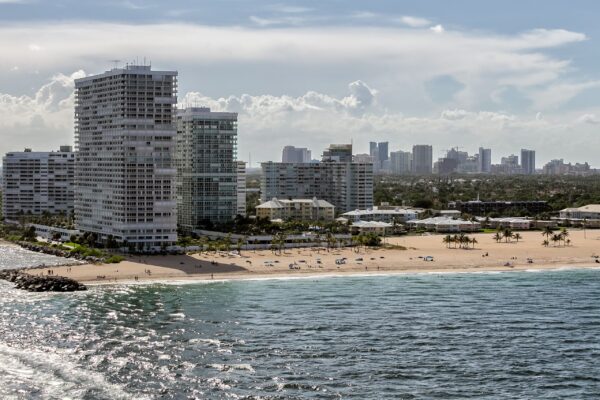
Miami Beach is associated with beaches, tourists and expensive property. Behind this outward appearance of prosperity lies a problem that has been discussed with increasing frequency in recent years. During high tides, streets are flooded, car parks are submerged, and residents regularly face the consequences of rising sea levels. The city no longer views this as a rare natural phenomenon. Flooding has become part of everyday life.
The situation around Miami Beach is increasingly being discussed by environmentalists. Engineers, architects, urban infrastructure specialists and property owners are all getting involved. The reason is simple: this is a long-term process that is gradually changing the urban landscape.
Why Miami Beach is vulnerable
The city’s defining feature is its geography. Miami Beach is situated on a narrow strip of land next to the ocean. A significant portion of the area lies almost at sea level. Even a slight rise in water levels begins to affect the streets, infrastructure and residential areas.
The soil structure adds to the complexity. Beneath the surface lies porous limestone, through which seawater can seep up from below. Because of this, traditional defences are not as effective as in other coastal cities. Water can bypass the barriers by seeping through the ground.
Another problem relates to the climate. Rising temperatures are affecting global sea levels, whilst storms and seasonal tides are becoming more pronounced. As a result, even a normal sunny day is sometimes accompanied by flooded roads without heavy rain.
What the flooding looks like today
Many tourists are encountering this problem for the first time. In the morning, the street looks normal, but within a few hours, water is already covering the car parks and the road. Sometimes the water level rises so high that cars end up partially submerged.
The most challenging periods coincide with so-called spring tides. This natural phenomenon is linked to the positions of the Moon and the Sun, causing the sea level to rise temporarily above normal. For Miami Beach, such days pose a serious challenge.
Flooding affects more than just transport. Constant contact with salt water accelerates the deterioration of infrastructure. Roads, engineering systems, pipelines and underground utilities are damaged. The city is forced to invest regularly in repairs and modernisation.
Why the problem isn’t limited to the coast
At first glance, it might seem that flooding only affects areas near the ocean. But the situation extends to a much wider area. The water begins to affect the rainwater drainage system, the sewerage system and underground utilities.
Even short-term flooding places a strain on municipal services. After heavy tides, some streets have to be temporarily closed. Some areas face disruptions to infrastructure. This affects residents and businesses.
An additional factor is the rising cost of property maintenance. Homeowners are forced to factor in the risk of flooding, insurance becomes more expensive, and the cost of protecting buildings increases.
What measures are already in place
The city authorities began addressing this issue several years ago. One of the solutions was to raise the level of roads in certain areas. Some streets have been rebuilt so that they are higher than before.
In Miami Beach, pumping stations have been actively installed. They help to drain water more quickly after high tides and heavy rain. Such a system does reduce the scale of flooding, but it does not solve the problem entirely.
The stormwater infrastructure is also being modernised. Old systems are being replaced with new ones designed to handle heavier loads. At the same time, additional engineering projects aimed at protecting the coastal zone are being discussed.
Why experts consider this a long-term problem
Experts note that the situation is not limited to a few difficult seasons. Sea-level rise is seen as a long-term process that could continue for decades. This is precisely why many solutions require a strategic approach. Engineers point out that infrastructure must be designed with future changes in mind. Systems that work today may prove inadequate in a few years’ time.
Environmentalists emphasise that the problem affects more than just one city. Miami Beach has become one of the most striking examples of how climate change is affecting coastal areas. Similar processes are being observed in other regions of the world.
How the property market has changed
The issue of flooding has gradually begun to affect the housing market. Buyers are now paying closer attention to a property’s elevation, the condition of its building services, and the area’s history of flooding. Some developers have started adapting their projects to these new conditions. Modern buildings take into account additional requirements for the protection of infrastructure, car parks and service areas.
That said, interest in property in Miami Beach has not completely disappeared. The city remains an important tourist and residential hub. Issues of sustainability and safety have become part of the discussion in virtually every major transaction.